


There are differences between German and English CVs! With an English CV, it also matters whether you are applying in the US or the UK, i.e., to a British or American company.
It starts with the name. You have probably heard the terms CV or résumé in connection with a CV before.
First, we will show you what generally matters in an English CV. We will then also look at the more specific differences between a CV (UK) and a résumé (US).
The most important steps for a successful English CV
State your objectives!
What do you want to achieve with your application for this position? Write these objectives down before you start your CV. This will help you focus on what matters and ensure you do not forget any relevant information. These objectives can be added at the top of the CV, directly below the address, with a heading such as “Objective” or “Personal Statement”. This is not strictly necessary, but it can help you stay goal-oriented.
Review and edit your CV!
Ideally, make a list of all previous jobs and educational qualifications. Write down everything you can remember, including company information, certificates, qualifications, and specific achievements, as well as voluntary work or similar. There does not need to be any order yet—this step is simply about collecting information that you will later arrange chronologically.
Choose the perfect (industry-appropriate) layout!
The truth is: there is no perfect CV layout. What matters is that it is clear, easy to read, and not too long. Make sure the layout suits the industry and looks professional. Remember that the person reading it will have seen hundreds of CVs, so make it easy for them to quickly see what a great candidate you are.
English CV: Structure
As a rule, address and contact details come at the beginning of the CV, followed by a personal statement.
The personal profile: Personal Statement
The Personal Statement is typical of an English CV. It consists of a few sentences right at the beginning of your English CV. In the UK, this section is not strictly necessary but viewed very positively, while in the US it is a must.
It can also be titled “Personal Profile”, “Personal Mission Statement” or “(Career) Summary”, but it does not necessarily need a title. This depends entirely on the layout of your résumé. Personal statements are mainly used for jobs in the private sector. Academic CVs, by contrast, rarely include personal profiles.
But how exactly do you write a personal statement?
Start with a sentence about yourself and mention your education and/or most important professional experience.
The personal statement should always reflect who you are and align with your own personal goals and experience. It should be tailored precisely to the position and your career goals.
Here are three examples of personal statements (source: novoresume.com)
#1: Personal Statement Example for Recent Graduate CV
As a recent graduate from university, with an honors degree in communications, I held several internships within leading organizations, including Bertelsmann. These internships enabled me to gain experience in the field and learn how to serve up valuable contributions in a fast-paced, professional environment.
Explanation:
This example should be adapted to include the university where you graduated and any relevant internships. A compelling personal statement always highlights relevant skills and experience. Since university graduates generally do not yet have a wide range of experience, soft skills should be emphasised in this case—for example, succeeding in a fast-paced work environment or developing into a trusted team member.
#2: Personal Statement Example for a Career Change CV
With over 15 years as a sales manager, I have extensive experience building high-functioning sales teams that consistently achieve budget numbers. In fact, my ability to grow talent led to a 20% increase in annual renewals across the board. Now, after 15 years, I am seeking new challenges to flex my marketing muscles in a fast-paced environment.
Explanation:
When changing careers, it is important to highlight skills that are transferable across industries. In this case, leadership and team-building experience can be applied in any industry. Identifying specific figures and percentages increases credibility when applying for a position. The applicant ends with the reason for the desired career change. This is not required, but it may appeal to some hiring managers who wonder what motivates the career change.
#3: Personal Statement Example for an Experienced Professional CV
As a friendly, professional and highly trained educator, I am passionate about teaching and have an innate ability to understand student’s needs. Creating a safe and productive environment for optimal learning is my top priority. I’ve worked as a teacher for nearly 10 years in a variety of subjects and my experience and skill set make me the perfect fit for your team.
Explanation:
With more experience comes more skills and a clearer understanding of strengths and weaknesses. Showing your passion for the industry is a great way to start a personal statement. It shows the hiring manager that you are dedicated to your craft.
After the personal statement, you then list professional skills, employment history (starting with your current or most recent position), academic and professional qualifications, and other interests at the end.
After the personal statement comes:
Professional experience: Work/Professional Experience
Here you can list both employment and internships.
- Full company name, location
- Exact job title and/or role description
- Period of employment
- Also mention your key achievements (Achievements), such as awards and successfully won contracts, if they match the advertised position. You can also list everything that indicates exceptional commitment under a separate subheading, Achievements & Accomplishments.
Higher education/school education, further training: Education
- Name of university, subject(s), thesis topic, grade (only if it is good), degree title
- Name of school and type of school, location, qualification, grade (see above)
- Primary school is omitted, as in a German CV
- Only list further training that is relevant to the job you are aiming for. If you have gaps in your CV, you can also use training courses to fill them.
Additional skills: Additional Skills
- Languages, level
- IT skills, level
- Driving licence (if relevant to the position)
Hobbies: Personal Interests/Activities
- Sport
- Culture
- Other
- Mention hobbies and interests that qualify you for your future job and spark interest.
References: References
The CV ends with two referees and their full contact details. These people should know you and be willing to provide information if contacted. Alternatively, you can offer to provide references on request: “References available on request”. Opinions differ as to which option is better.
Distinguish between a CV and a résumé
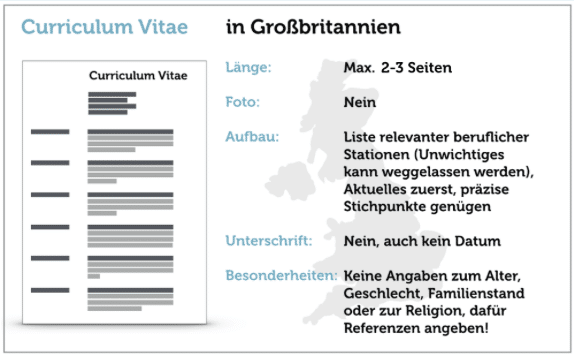
CV
A CV (Curriculum Vitæ) is a detailed document that can be two or more pages long and contains detailed information about your experience and skills. It covers education as well as other achievements such as publications, awards, honours, etc.
An English CV is strictly reverse chronological. This means your current position appears at the top, while education is only mentioned at the end. This is intended to make it easier to get an overview of a person’s entire career. A CV is static and does not change for different positions; the difference in an application then lies mainly in the cover letter.
Résumé
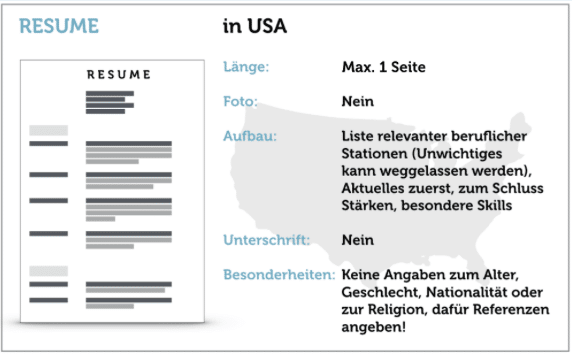
A résumé is a concise document that is usually no longer than one page, as it is intended to give the reader only an overview.
Job seekers should always tailor their CV to the position they are aiming for and may need to adjust the information, as recruiters only need the key facts here. A résumé does not have to be in chronological order, does not have to cover the entire career, and is a highly adaptable document.
Unlike a CV (and the German/Austrian CV), in the US and Canada it is mandatory to provide at least two references. Since they play a major role in the application process, references should be able to confirm your suitability. In addition, the referee’s details must be complete so they can be contacted for further questions.
So now we know:
CV – long, covers the entire career, static
Résumé – short, no fixed formatting rule, adaptable
But where exactly is the difference compared to a German/Austrian CV?
Differences between English and German CVs
As we have seen, there are some differences between the German CV we are familiar with and the English one. That is why you should never simply translate your German version into English word for word. The two CV formats differ in the following points:
| GERMAN | ENGLISH |
|---|---|
| PHOTOS | |
| In Germany, an application photo is considered good practice and is often expected. Applications without a photo are extremely rare. | Including application photos in a CV is the exception and is often not desired by companies. This is intended to reduce the risk of discrimination. |
| PERSONAL DETAILS | |
| Personal information such as date of birth or marital status does not have to be provided. However, it is still common. | Whether date of birth, gender, marital status or religion—these details have no place in an English CV. Here too, the aim is to minimise discrimination. |
| STRUCTURE | |
| The structure of a German CV can be designed in different ways. In addition to the chronological format, there are also functional and tabular CVs. | An English CV is strictly reverse chronological. This means your current position appears at the top, while education is only mentioned at the end. |
| REFERENCES | |
| Providing references is not mandatory in Germany, but it can earn you plus points and support your skills. | In the US and Canada, it is mandatory to provide at least two references. Since they play a major role in the application process, references should be able to confirm your suitability. In addition, the referee’s details must be complete so they can be contacted for further questions. |
| SIGNATURE | |
| The CV is signed and dated. | The CV is not signed. The date is not included either. |