

Which countries are part of Scandinavia?
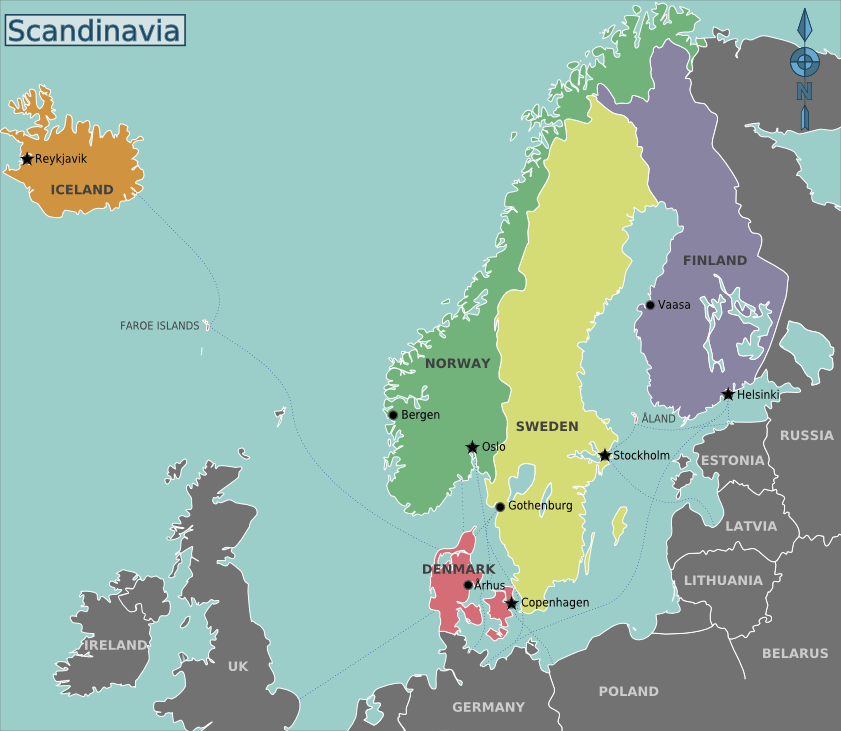
Scandinavia is the part of Northern Europe that includes the countries Norway, Sweden and Denmark. In a broader sense, all of Finland and, less commonly, Iceland and the Faroe Islands are also counted as part of Scandinavia. From a historical perspective and in linguistic and cultural terms, however, Scandinavia in the narrower sense consists of Sweden, Norway and Denmark.
Where do the linguistic differences lie?
The three Scandinavian standard languages, Danish, Norwegian and Swedish, are closely related, which is why speakers can understand one another. Does that mean that if you know one of the languages, you speak them all? Let us take a closer look at the Scandinavian languages—or rather the North Germanic languages.
In fact, the three Scandinavian languages—Danish, Norwegian and Swedish—have so much in common that they could almost be regarded as dialects. Anyone who speaks one can understand speakers of the others, at least to a certain extent. The three languages developed from Old Norse—often called the Viking language. They form the north-eastern branch of the Germanic language family tree, while Icelandic and Faroese make up the north-western branch. Although Finland may be considered part of Scandinavia depending on the definition, the Finnish language is related to Hungarian, Sami and Estonian and does not even belong to the Indo-European languages.
Swedish has the largest number of speakers, at ten million. The other two each have around five million speakers.
The main difference between Danish and Norwegian lies in the spelling and pronunciation of words. In some cases, a particular word is used in Norwegian and a different one in Danish. In almost all cases, however, both words exist in the other language as well and have almost the same meaning. An example in English is “tooth paste” and “tooth cream”. Danes and Norwegians can read the other language just as well as their own. With Swedish, the differences are greater, and Danes and Norwegians need to make more effort to understand the language.
Mutual understanding, however, is simply a matter of practice—just as when an American tries to learn to understand a Scottish person. There are new words, of course, but it is often possible to make yourself understood.
This is how Swedes, Norwegians and Danes say “What is your name?”:
Hvad hedder du? (Danish)
Vad heter du? (Swedish)
Hva heter du? (Norwegian)
As you can see, the spelling is very similar. That is why it is often very easy for someone who already has command of one of the languages to learn another of these languages.
The difference from Finnish becomes clear here:
Would you have known?
In addition, if you are not from the Nordic countries, you may not know that Swedish has a sister. A sister that was an official language for much longer—in neighbouring Finland.
Finland Swedish (Finlandssvenska) is a group of East Swedish dialects spoken in the Åland Islands and along Finland’s west coast in cities such as Vaasa (Vasa), Turku (Åbo) and Helsinki (Helsingfors). However, bilingualism is more pronounced in more rural areas.